Random news from here
Dave is settling into college for the spring semester and seems happy with most things, including the courses that he's taking. Only drawback he's found so far is the food fare for a vegan. He stopped eating all meat products about six months ago. At home here it's been a welcome challenge for him because we have several stores and restaurants that cater to vegan diets, and he enjoys cooking new recipes. But living in a dorm and using the food plan, he will have to adjust somewhat to their offerings, combined with trips out to the local markets.
I run a community leadership program and we just completed our opening retreat for this year's class. Late one night, after the sessions had ended, someone in the class showed the movie, "The Core" which is a 2003 thriller with Hilary Swank. It looked like lighthearted fare after a busy day, so I settled in to watch it, too. The first scene is about 32 people who all die at the same moment within a 20 block radius. The only thing they have in common: they all have pacemakers! This was a wacky movie, and very far-fetched, but it did grab my attention. Yikes!
Healthwise things are quiet these days with both my husband and son. Checkups have been routine. I continue to seek out information and news about Brugada Syndrome and ICDs.
Saturday, January 13, 2007

Friday, December 15, 2006
Brugada Syndrome Studies
I like to scan the web for new articles about Brugada Syndrome. Here are a few:
This first study takes a closer look at the presence of these telltale waves on ECGs of Brugada patients. The purpose was to prospectively evaluate the spontaneous ECG changes between diagnostic and non-diagnostic ECG patterns in patients diagnosed with Brugada Syndrome.
They looked at over 300 ECGs of 43 diagnosed patients, and noticed that over time, some ECG were non-diagnostic, and then the waves reappeared. Only one patient showed consistent patterns of the coved-type ECG pattern. This has significant implications for determining relative risk, and correct phenotyping.
Here is another study. Now this link is to another blog. Not to discredit we bloggers, but please remember to consider the source. If an article I site or quote from interests you, please check out the primary source and don't be satisfied with comments on a blog. I'm not a health care professional. Just the mother and wife of two people with Brugada Syndrome! Anyway, the study in this article is interesting because it's a look at 220 Brugada patients with ICDs and the frequency of shock therapy, both inappropriate and appropriate. Seems as though inappropriate shocks happened 2.5 more frequently than appropriate ones. That is just terrible! Still, I don't think anyone wants to consider not having an ICD if you have a confirmed diagnosis.
I like to scan the web for new articles about Brugada Syndrome. Here are a few:
This first study takes a closer look at the presence of these telltale waves on ECGs of Brugada patients. The purpose was to prospectively evaluate the spontaneous ECG changes between diagnostic and non-diagnostic ECG patterns in patients diagnosed with Brugada Syndrome.
They looked at over 300 ECGs of 43 diagnosed patients, and noticed that over time, some ECG were non-diagnostic, and then the waves reappeared. Only one patient showed consistent patterns of the coved-type ECG pattern. This has significant implications for determining relative risk, and correct phenotyping.
Here is another study. Now this link is to another blog. Not to discredit we bloggers, but please remember to consider the source. If an article I site or quote from interests you, please check out the primary source and don't be satisfied with comments on a blog. I'm not a health care professional. Just the mother and wife of two people with Brugada Syndrome! Anyway, the study in this article is interesting because it's a look at 220 Brugada patients with ICDs and the frequency of shock therapy, both inappropriate and appropriate. Seems as though inappropriate shocks happened 2.5 more frequently than appropriate ones. That is just terrible! Still, I don't think anyone wants to consider not having an ICD if you have a confirmed diagnosis.
Monday, October 30, 2006
Article on Brugada Syndrome in November's Discover Magazine
That's right. A physician who runs an Emergency Department tells the story of a healthy man with syncope being sent home because his tests are normal. Even though another doctor notices something unusual on the ECG, the patient is sent on his way.
It turns out he has Brugada Syndrome. Don't worry, the ending is good. And this short article give a brief, no-nonsense summary of the history of the disease along with the reasons that its diagnosis can be so difficult. It is rare - he cites the statistic of less than one half of one percent of people in the United States may have Brugada.
Still that number is too large to ignore, methinks.
In other news, I listened to a speech by Phil Romano last week. He was the keynote at a local annual dinner. He is a restauranteur, and developed Fudruckers, Macaroni Grill, and others. He's from this town. Anyway, he's a good speaker and storyteller. He's also a venture capitalist, and his interest is in medical research. One idea he funded and sold to Johnson & Johnson (for millions, I might add) was for a cardiac stent. Currently, he's invested in the development of a chip that can read glucose levels transdermally. It could fit inside a watch, perhaps, someday. I am grateful for the Phil Romanos in this world. I don't know where we'd be without them.
That's right. A physician who runs an Emergency Department tells the story of a healthy man with syncope being sent home because his tests are normal. Even though another doctor notices something unusual on the ECG, the patient is sent on his way.
It turns out he has Brugada Syndrome. Don't worry, the ending is good. And this short article give a brief, no-nonsense summary of the history of the disease along with the reasons that its diagnosis can be so difficult. It is rare - he cites the statistic of less than one half of one percent of people in the United States may have Brugada.
Still that number is too large to ignore, methinks.
In other news, I listened to a speech by Phil Romano last week. He was the keynote at a local annual dinner. He is a restauranteur, and developed Fudruckers, Macaroni Grill, and others. He's from this town. Anyway, he's a good speaker and storyteller. He's also a venture capitalist, and his interest is in medical research. One idea he funded and sold to Johnson & Johnson (for millions, I might add) was for a cardiac stent. Currently, he's invested in the development of a chip that can read glucose levels transdermally. It could fit inside a watch, perhaps, someday. I am grateful for the Phil Romanos in this world. I don't know where we'd be without them.
Tuesday, August 08, 2006

Brugada Syndrome and Atrial Flutter: Is There A Correlation?
I've always wondered about the relationship between atrial flutter or atrial fibrillation and Brugada Syndrome.
In fact you can read article after article about Brugada Syndrome and find nary a mention of atrial flutter.
Back in 1985 my husband went to the doctor for a routine check-up and was discovered to have atrial flutter. The cardiologist told him that some people spontaneously develop conditions and since he was otherwise healthy, the best thing would be to manage the flutter with digoxin.
Fast-forward to 2004 when our son was diagnosed with atrial fibrillation at age 16. He was cardioverted back to normal rhythm. The photo above was taken after he was shocked. The paddles left burns on his chest and back. He was anesthesized first, of course! The pediatric cardiologist was very interested in the family history. And they decided to manage my son's rhythm with digoxin as well.
Six months later both father and son had ICDs implanted for protection against sudden death after their Brugada Syndrome diagnoses. And my husband also was ablated to repair his atrial flutter.
Today my husband had his first appointment with his new cardiologist, Dr. Ramon Brugada. (Yes, the very same Dr.Brugada whose brothers identified the syndrome originally and who has authored so many studies on the disease.) After studying the ICD readings Dr. Brugada reported that my husband has been in atrial flutter off and on over the past six months, sometimes for ten consecutive days. For now, we are taking a wait-and-see approach, and if he has more incidences he will have to be ablated again.
So back home I began to search around to see if anyone has studied this connection between atrial flutter and BS. I found one article and plan to keep looking for others. This article identifies a higher incidence of atrial flutter or fibrillation in BS patients than the general population, but the most interesting part of the study is that they conclude that the most serious cases of Brugada Syndrome are the ones with atrial flutter. Not something that makes me feel good!
When my husband told me about his appointment at first I was pretty concerned about the flutter - I thought he was out of the woods at least regarding his atrium! But apparently you can develop new flutters even after being ablated. At least we have some explanations now for some weird sensations he's been having, sometimes after he's been traveling long distances.
Dr. Brugada also saw our son today, because of the familial connection, and took ECGs of both men. He is so knowledgeable and interesting it is wonderful to know that he's my husband's doctor.
Saturday, March 04, 2006

I cannot relax.
My son and husband were diagnosed with Brugada Syndrome over a year ago. There is no cure. They both have been fitted with ICDs (implantable cardiac defibrillators). They see their physicians on a regular basis for check-ups, and are doing fine. They seem to have adjusted well to this diagnosis and follow-up treatment, which mainly consists of checking their health, and keeping their ICDs functioning and up-to-date.
Brugada Syndrome really has no symptoms. There is no outward sign of the disease. So, the drama of the diagnosis and ICD has settled into routine management of a serious, but not limiting, condition.
Still I cannot relax.
Why?
Because I have two children. My son is 18 and daughter, 23 (above, 1989) and they share identical genetic make-up from their parents. In a few years, they will begin families of their own. What about their babies? Will they be screened for Brugada Syndrome after they are born? What if there is still no treatment or cure? Will they, too, face a lifetime of re-checks and surgeries for their ICDs as their little bodies grow?
And, what if they are screened and the Brugada pattern does not appear on their EKGs? Does this mean that they don't have the Syndrome - and we can relax? Or does it mean that it simply hasn't show up yet? And if that's the case, how often then should they be screened? Should the family also be concerned about sudden infant death, which has been associated with Brugada? How is the risk different for infants of Brugada patients and their siblings who manifest the Brugada pattern, and those who do not?
No, I can't relax until there is more known about this disease and about how to treat it. I can't relax for my husband or my son or my future grandchildren, or the grandchildren of other Brugada patients and their families.
If you have Brugada Syndrome, you might consider participating in the genetics study. You can read about it at www.brugada.org. And of course, I hope those who can contribute financially to the foundation established by the Brugada family, will do so!
Wednesday, February 15, 2006

Brugada Syndrome is the subject of at least two books, one published last year.
The Brugada Syndrome: From Bench To Bedside , by Charles Antzelevitch (editor), Pedro (Ph.D.) Brugada (editor), Joseph (M.D.) Brugada (editor) and Ramon (M.D.) Brugada (editor) is currently available to purchase at all the major outlets. It is a bit dry reading for the mainstream audience, but I think family physicians, internists, E.R. staff and pediatricians should own it to use as a reference resource in their office. And Brugada Syndrome patients and their families might find the book interesting on a personal level.
Not a huge seller, Amazon currently ranks it #1,479,777 in book sales.
Wednesday, January 04, 2006
Dave had a check up at the cardiologist office today.
Everything went well even though the doctor discovered one "event" that happened last month. His ICD picked up a reading of acceleration and began to track the heart's activity. Upon investigation, they realized that this happened the day Dave was packing up his car to come home for Thanksgiving break, and probably took the stairs a couple of times instead of waiting for the elevator.
That's ten flights each time.
His heart rate was fine, he didn't even begin to approach tachycardia. The doctor speculated that the heartrate threshold programmed in the ICD was a bit too low for someone Dave's age and activity level, and raised it.
So, he's doing well, the ICD is working properly and Dave doesn't have to go back again until May. Good news all.
Everything went well even though the doctor discovered one "event" that happened last month. His ICD picked up a reading of acceleration and began to track the heart's activity. Upon investigation, they realized that this happened the day Dave was packing up his car to come home for Thanksgiving break, and probably took the stairs a couple of times instead of waiting for the elevator.
That's ten flights each time.
His heart rate was fine, he didn't even begin to approach tachycardia. The doctor speculated that the heartrate threshold programmed in the ICD was a bit too low for someone Dave's age and activity level, and raised it.
So, he's doing well, the ICD is working properly and Dave doesn't have to go back again until May. Good news all.
Sunday, January 01, 2006
Brugada.org has a new forum for those with questions about Brugada Syndrome.
Check it out!
Nothing much new to report here. I've become aware of how much trouble my husband has sleeping since he had his ICD implanted a year ago. He's always slept on his left side, and he's 54 years old. Well his ICD is on the left side of his chest and so he often tosses and turns all night. When he does sleep successfully on his left side, he said that the site of the implant aches the following day.
Not sure there is really a solution to this problem, but anyway, it's too bad. Maybe we'll look into some sort of sleep aid like a special mattress to retrain his body to sleep on the right side.
Oh...did I mention that when he doesn't sleep well...I don't sleep well either??
Check it out!
Nothing much new to report here. I've become aware of how much trouble my husband has sleeping since he had his ICD implanted a year ago. He's always slept on his left side, and he's 54 years old. Well his ICD is on the left side of his chest and so he often tosses and turns all night. When he does sleep successfully on his left side, he said that the site of the implant aches the following day.
Not sure there is really a solution to this problem, but anyway, it's too bad. Maybe we'll look into some sort of sleep aid like a special mattress to retrain his body to sleep on the right side.
Oh...did I mention that when he doesn't sleep well...I don't sleep well either??
Sunday, December 11, 2005
Monday, October 17, 2005
So Dave is really going to do it.
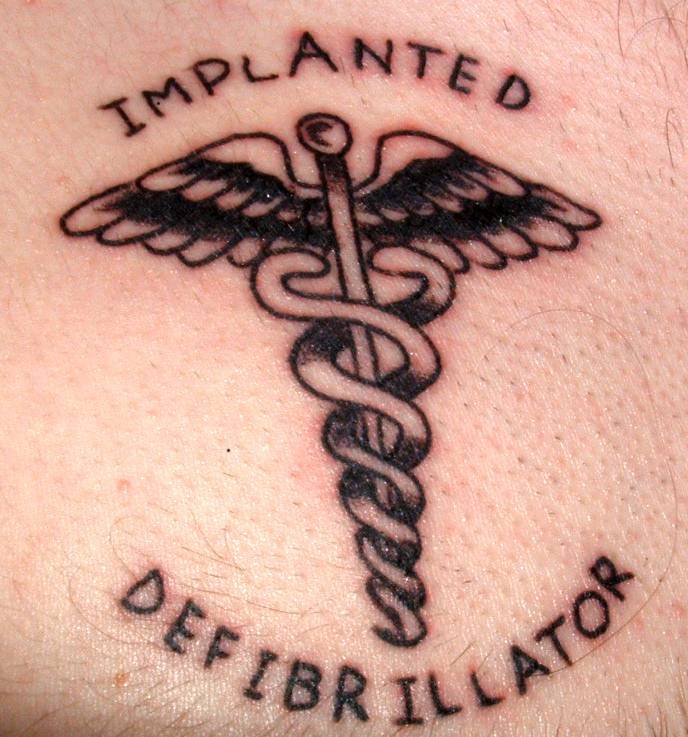
He's going to get a tattoo next weekend.
I'm glad I didn't come of age in a time when tattoos were a "rite of passage". Perfectly normal young people who would consider tattoos to be an unacceptable insult to their bodies become enamored with the idea right around their 18th birthday. What a coincidence: when you turn 18 in New York State, you can legally go get yourself a tattoo. And many do.
Of course I "googled" the relative safety of getting a tattoo if you happen to have an implanted defibrillator in your chest. The results were mixed. Apparently some of the equipment used in the process of applying the paint contain magnets but pose no greater danger than, say, your cell phone. Keep it 6 inches from your ICD and you'll be fine, they say. Others seem to think that the wise thing to do is to skip it. But that information was probably written by an OLD PERSON. (You know, over 50.)
I'll post a photo of Dave's tattoo here next week. Dave, send me a photo, will you?
He's going to get a tattoo next weekend.
I'm glad I didn't come of age in a time when tattoos were a "rite of passage". Perfectly normal young people who would consider tattoos to be an unacceptable insult to their bodies become enamored with the idea right around their 18th birthday. What a coincidence: when you turn 18 in New York State, you can legally go get yourself a tattoo. And many do.
Of course I "googled" the relative safety of getting a tattoo if you happen to have an implanted defibrillator in your chest. The results were mixed. Apparently some of the equipment used in the process of applying the paint contain magnets but pose no greater danger than, say, your cell phone. Keep it 6 inches from your ICD and you'll be fine, they say. Others seem to think that the wise thing to do is to skip it. But that information was probably written by an OLD PERSON. (You know, over 50.)
I'll post a photo of Dave's tattoo here next week. Dave, send me a photo, will you?
Sunday, October 02, 2005
I caught most of a television interview this morning with Dr. Ramon Brugada. He was answering questions about Brugada Syndrome and implantable defibrillators. ICDs are the treatment of choice, but there are places in the world where they are simply too expensive an option. So research is continuing to find a more affordable treatment. He said administering quinidine is being considered as an alternate to having an ICD implanted. Unfortunately it currently has a 20% no-effect rate which is way too high. Dr. Brugada said he would not replace the ICD with quinidine in most circumstances.
At the end of the interview, the moderator asked Dr. Brugada what advice he offers the average person regarding Brugada Syndrome, and Dr. Brugada said that if a young healthy person dies in your family and the cause of death is not apparent, the family should see their doctor to investigate whether or not they might have Brugada Syndrome, but otherwise, this isn't the kind of thing that one should worry needlessly about.
I like Dr. Brugada and his reassuring approach to healthcare management for this condition. I also defer to his experience and knowledge on the topic. Perhaps concerns that I expressed in an earlier post may be unwarranted. Still, I know that when I hear of someone with unexplained spells of blacking out, or an episode of SIDS in the family, I always suggest that an ECG be reviewed to rule out Brugada Syndrome. But that's just me.
At the end of the interview, the moderator asked Dr. Brugada what advice he offers the average person regarding Brugada Syndrome, and Dr. Brugada said that if a young healthy person dies in your family and the cause of death is not apparent, the family should see their doctor to investigate whether or not they might have Brugada Syndrome, but otherwise, this isn't the kind of thing that one should worry needlessly about.
I like Dr. Brugada and his reassuring approach to healthcare management for this condition. I also defer to his experience and knowledge on the topic. Perhaps concerns that I expressed in an earlier post may be unwarranted. Still, I know that when I hear of someone with unexplained spells of blacking out, or an episode of SIDS in the family, I always suggest that an ECG be reviewed to rule out Brugada Syndrome. But that's just me.
Monday, September 26, 2005
 Here is a lovely tee shirt that belongs to Dave.
He purchased it through Medtronic Corporation, the manufacturer of his and Jim's ICDs.
Jim has his own Medtronic shirt. It's a real hoot whenever one of them has this shirt on!
While driving home from the store this evening, I heard Medtronic Corporation named as a sponsor of BBC World News heard on National Public Radio. Go Medtronic!!
Sunday, September 25, 2005
World Heart Day 2005


David in the summer of 1988,
hand over heart! Very cute!
hand over heart! Very cute!
Do you know the difference between cardiac arrest (heart attack) and sudden cardiac death? They both sound pretty ominous! Well here is an explanation that a cardiologist offered to me: think of cardiac arrest as a problem with the plumbing. There is a clog or obstruction somewhere which is severely affecting the flow of blood to the heart. There can be varying levels of the problem. A person having a heart attack may experience several symptoms such as arm or jaw pain, nausea, stomach upset, chest pains. Heart attacks can cause minor damage to the heart muscle - or they can be fatal. It is imperative that a person in cardiac arrest receive medical intervention immediately. Long term treatment may involve heart bypass surgery, lifestyle changes, and medications such as blood thinners, beta blockers, and such.
In contrast, "sudden cardiac death" can be described as an electrical problem. There is a power failure, as though somebody just switches the power off. Period. There are no painful symptoms. Your heart stops beating properly, and within seconds, you lose consciousness. There is no treatment for Sudden Cardiac Death brought on by Brugada Syndrome. This is why patients are fitted with an implantable defibrillator.
We aren't sure exactly how common Brugada Syndrome exists in the population, one 2002 Italian study found "The current prevalence estimate is 1-5/10.000 in the Western countries. Higher frequency (1/2500) may be found in eastern countries, especially Thailand, where BrS is considered the major cause of sudden death in young individuals."
So in our small town, perhaps 5 to 10 people are walking around with Brugada Syndrome. And that is only one of several serious, diagnosable conditions that may lead to sudden cardiac death. There are others, such as Marfan Syndrome, or Long QT Syndrome. Should people be screened for these conditions, so that they may receive treatment?
In the United Kingdom, there is an active movement to raise awareness of sudden death syndrome and generally, cardiac risk of the young. One organization, C-R-Y, is working with the medical community to establish a national screening program. It recommends that youngsters receive a few screening electrocardiographs over the course of several years, with special attention to young athletes, a group at special risk for some cardiac conditions.
Electrocardiographs are noninvasive, quick and easy screening methods. But they aren't free. Is it worth the time and money to screen millions of people for such a rare condition?
The next time you read a sad story about a young healthy person who dies in her sleep, think about it: a routine screening electrocardiograph, conducted years earlier, just might have saved her life...
Saturday, September 24, 2005

Did you know that World Heart Day is Sunday, September 25?
Bill Clinton (former pres) and Roger Federer (current tennis star) both support the World Heart Association and announced World Heart Day through a joint press release. President Clinton had heart bypass surgery a year ago after experiencing chest pains. He maintains a healthy lifestyle, eats smart and stays fit. His Foundation is working hard to promote heart health.
Roger Federer, currently ranked the number one player of professional tennis, is the spokesperson for United Nations International Year of the Sport and Physical Education. You might have caught him beating Andre Agassi earlier this month. Wow was that a terrific match or what!! Anyway, he said, "Where ever you live in the world, moderate but regular exercise is extremely important. A small amount of exercise can make a big difference and help you have a healthy heart for life, too."
The World Heart Association is based in Geneva, Switzerland. Here in the U.S. , the American Heart Association, the American College of Cardiology, and the Children's Heartlink each have activities planned to promote awareness of heart health.
Sunday, September 18, 2005
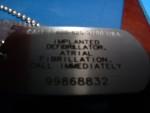
So you have an ICD...Medic Alert tags - to wear or not to wear? - this is the question. (Here's a picture of Dave's.)
Both Jim and Dave ordered and received medic alert tags after they had their ICDs implanted. It's just good planning, I guess. There IS a sizeable scar on their chests, and I'm sure any EMT worth his or her salt would immediately realize there was something in there besides the ticker.
But just in case, it's good for the ambulance crew to know about the ICD. You definitely don't want someone who thinks you are cardiac arrest or some other heart problem thinking about giving you the paddles on top of your ICD. This would definitely not be good. The great thing about Medic Alert is that you are also registered with an ID number, and your medical information is available to help the staff learn about your condition almost immediately in case of emergency.
Only one problem. Dave won't wear his tag. He says it's uncomfortable. He worked as a line cook this past summer, and said that it really bothered his skin in all the heat. I think the tag is currently on his set of keys. So what good is it there?
Dave's decided that it would be much more efficient to have his medic alert "tag" tattooed directly to his chest. The other side from the ICD of course. So this is the plan. In a couple of weeks, he'll visit the tattoo parlor with a clear drawing of the emblem, and have it - shall we say - implanted.
I just don't understand tattoos.
Thursday, September 15, 2005
Dave had his four-month check-up at the cardiologist's office yesterday. The staff in this practice is very thorough. As Dave lay flat on his back, they placed a mouse-sized gadget on his chest over the defibrillator implant, where it "read" the ICD and fed the data into the computer. In addition to reading the information on the computer screen, they also print out a report that tells about any cardiac events that have been recorded, such as pacing the heart, or a shock. The doctor had a couple of medical students with him so he remarked aloud while reviewing the readout from the ICD report. It was all good news. Dave has had no problems and the ICD battery remains strong. The doctor told us that he continues to see evidence of Brugada Syndrome on Dave's ECGs however. This doesn't surprise us, although it is common for the unique waves to appear occasionally but not always. It wouldn't change the diagnosis either way.
Dave's and Jim's surgeries were nearly a year ago, in October of 2004. Sometimes it seems as though years and years have passed since then. For lots of reasons.
I've added a link about Brugada Syndrome. It's from a different perspective - a website about genetic conditions, not cardiac conditions. Interesting reading.
Dave's and Jim's surgeries were nearly a year ago, in October of 2004. Sometimes it seems as though years and years have passed since then. For lots of reasons.
I've added a link about Brugada Syndrome. It's from a different perspective - a website about genetic conditions, not cardiac conditions. Interesting reading.
Monday, September 05, 2005
I've been watching the news coverage of Katrina, the devastating hurricane that has ravaged much of the gulf coast of the United States. It is heartbreaking. The overwhelming stories of the people who have lost everything brings tears to my eyes. And I have seen local government officials, members of the news media, and first responders break down from sheer frustration and exhaustion. The number of lives lost grows by the hour. Thank you to the countries from all over the world who have offered to help with money or services. I have faith that the areas will be rebuilt to their previous splendor, with better protection from storms, and people will be able to return to their old neighborhoods and rebuild their lives. My heart goes out to all who have been affected by the storm, and to those who have stepped up to help.
Tuesday, August 16, 2005
 The Great Race
In this photo is my son, Dave, in the center, with friends Mike (left) and Ben (right). Two days ago they participated in a popular annual run, bike and paddle race here in our town. They did a great job and had fun. Here they are recovering from the grueling canoe leg. They called their team "Dead Last" because they didn't do any serious training for the event, and expected to place last. But they didn't! Far from it. They were pleased.
The only time Dave's cardiac condition was an issue had to do with his defibrillator. It's recommended that ICDs be kept away from strong magnetic fields. This race uses a transponder system to accurately log times. This involves wearing a small disk, the size of a coin, that will be activated when the racer runs through a magnetic field. How strong is the field? Would it trigger Dave's ICD? He didn't know and so they simply made sure that the relay person was someone else on the team. Mike, not Dave. Mike met up with the biker, then ran to the canoe, and he and Dave were off.
Friday, August 12, 2005

Brugada Syndrome is more common that you might think.
Brugada Syndrome may be responsible for up to 50% of all sudden deaths that occur in individuals with apparently normal hearts. On the website maintained by the Brugada brothers who first identified the syndrome, they estimate that it may be indicated in somewhere between 4 and 12% of all sudden deaths.
A study of the ECGs of 12,000 non-cardiac patients in a large urban teaching hospital was undertaken to determine how many of them exhibited the classic Brugada Syndrome pattern. The results showed that 52 were found to have ECG patterns specifically consistent with Brugada Syndrome. The authors of this study note that Brugada Syndrome is much more prevalent than previously thought.
To put it into perspective, this means that in a high school with 2,000 students, you might expect that there are 7 students in that population who would test positive for Brugada Syndrome. Sobering information. In a future post, I'll discuss the status of routine ECG screenings of children in our country compared with other industrialized countries.
So if this is true, why haven’t we heard of it more often? Well, it is not a new disease, but it is newly diagnosed. Brugada Syndrome was first identified back in the early nineties by Drs. Josep and Pedro Brugada. It is hereditary, but having the syndrome doesn’t necessarily mean that the patient will be struck down by it. In my husband Jim’s case, he had no memory of anyone in his parents’ families dying young and healthy. It may skip a generation, or the affected relatives may have died of other causes before they might have suffered from a cardiac event brought on by Brugada Syndrome. Unfortunately, the statistics for long term survival of known Brugada patients are not great. The ICD is the only way to be absolutely sure a patient will survive sudden cardiac death.
In instances of young healthy children or adults dying with no explanation, or sudden crib death, or even episodes of fainting that can’t be explained otherwise, the survivors or patients should definitely be screened for Brugada Syndrome.
Because so many physicians in the United States have never encountered Brugada Syndrome, the onus may be on the patient to be diligent about follow-up if any of the circumstances I described above happen in your family. This is such a new syndrome, and the research is ongoing, that it’s possible for a very good physician to simply not be familiar with the disease.
(photo above is of my son Dave and daughter, Jessica, outside the White House lawn in 1990.)
Wednesday, August 10, 2005
How it all started…
The cardiologists told us that Dave was a healthy teenager, and his heart was strong and normal. They were at a loss to explain why it spontaneously developed an arrhythmia. But the digoxin, to help prevent further occurrences, and follow-up visits, reassured us and Dave went home and picked up life exactly where he’d left off three days earlier.
Six months later, during his follow-up visit, the doctor noticed a unique wave pattern in Dave’s ECG. We learned that day the Dave most likely had Brugada Syndrome. It's rare, and isn’t usually associated with cardiac arrhythmias or flutters. How fortunate we were, that Dave was under the care of cardiologists with the skill to notice this elusive condition. The gave us sobering news: if Dave did have Brugada Syndrome, he was at risk of experiencing sudden cardiac death at any time.
Brugada Syndrome is usually confirmed during an electrophysiology study (EP study) in which a catheter is threaded from a large vein in the groin to the heart. Here electrical activity can be studied and any arrhythmias can be mapped. The ventricle (lower chamber) is then prodded into fibrillation in a controlled setting. A healthy heart will not go into fibrillation. Another method that can be employed is to introduce certain drugs to stimulate fibrillation.
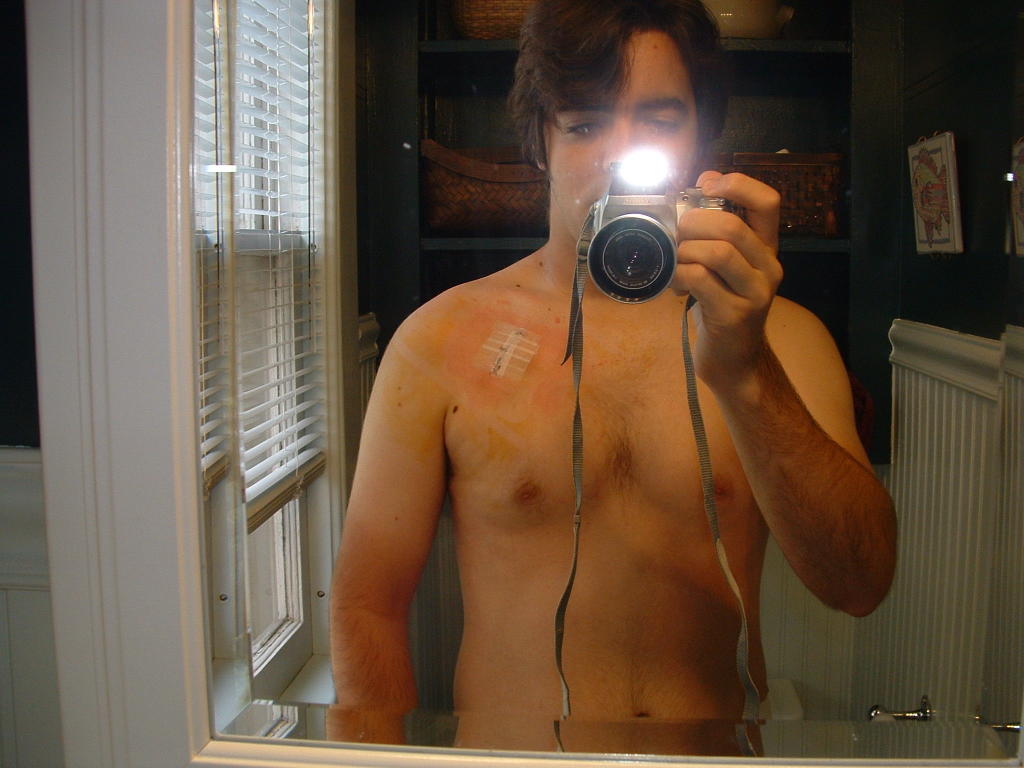
Dave went through the EP study, which confirmed his diagnosis. Before we had begun to absorb what was happening, he was scheduled for next day surgery to have an ICD (implantable cardioverter defibrillator) installed. This seems like a drastic step to take because the surgery is invasive and the ICD is costly. But we learned that there is no cure for Brugada Syndrome. The ICD will shock Dave’s heart back into sinus rythym if he has a Brugada event. Since Dave was at risk of sudden cardiac death, the choice here was simple. His ICD is the only assurance we have that Dave will survive such an event. At the top of this post is a picture of Dave taking a photo of his incision site the day he returned home from the hospital with his ICD.
The story doesn’t end here. Brugada Syndrome is hereditary. Our whole family was tested, and blood drawn for genetic study. My daughter and I showed no characteristic waves in our ECG strips, but Dave’s father, Jim, was found to have the syndrome. He, too, endured the EP study, and the subsequent surgery to have an ICD implanted. During the EP study was able to have an existing atrial arrhythmia condition treated successfully through a procedure called cardiac ablation, and this was good.
The doctor told my daughter that because her genetic make-up is identical to her brother's, she should have a new ECG strip run every now and then and sent to him for review just in case. Another confounding element of Brugada Syndrome is that is doesn't present in an ECG every time, it may appear and disappear over a person's lifetime.
Subscribe to:
Posts (Atom)